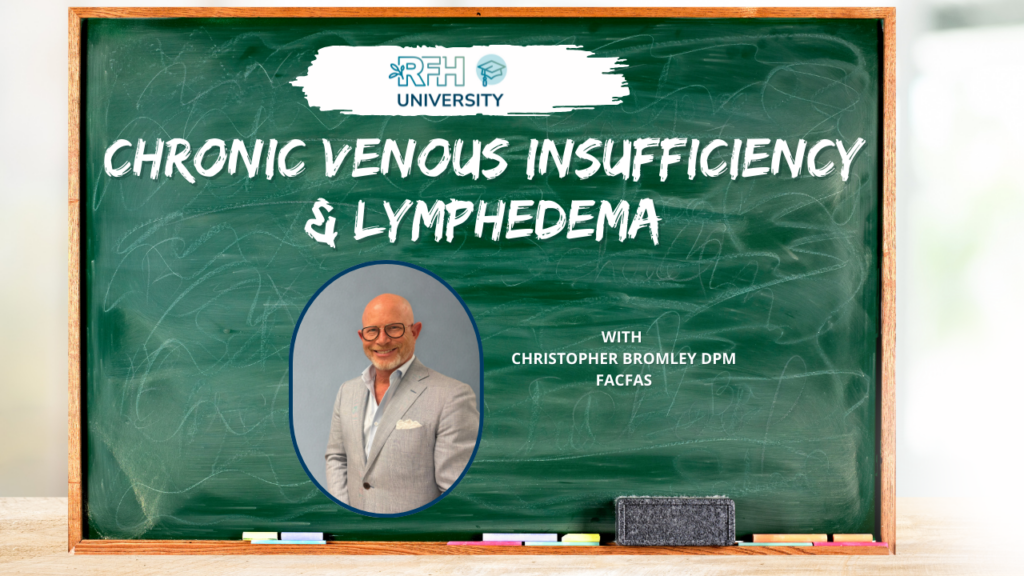
Chronic venous insufficiency (CVI) and lymphedema affect millions of patients in the United States and are leading contributors to delayed wound healing, chronic edema, and reduced mobility. Despite how common these conditions are, it is often under-diagnosed and under treated, especially in patients receiving care at home.
In a recent RFH University education session, Dr. Christopher Bromley, Chief Operating Officer at Restore First Health, provided an in-depth clinical overview of chronic venous insufficiency, secondary lymphedema, and their impact on wound healing outcomes.
What Is RFH University?
RFH University is a free, monthly educational series hosted by Restore First Health. These sessions are designed for clinicians, agency partners, and care teams who support patients with chronic conditions, wounds, edema, and vascular disease.
Each RFH University session focuses on:
- Evidence-based clinical education
- Practical assessment and documentation strategies
- Early identification of conditions that delay wound healing
- Real-world treatment considerations for in-home care
RFH University helps providers stay informed, aligned, and better equipped to care for patients with complex needs, at no cost.
Why Chronic Venous Insufficiency and Lymphedema Are So Common
Chronic venous insufficiency is significantly more prevalent than peripheral arterial disease and is one of the most common underlying causes of lower-extremity swelling, skin changes, and venous ulcers.
As explained in this RFH University session, CVI occurs when venous valves fail, allowing blood to flow backward and pool in the lower extremities. This leads to venous hypertension, which directly interferes with arterial blood flow at the capillary level, slowing tissue repair and wound healing.
Over time, untreated CVI frequently leads to secondary lymphedema, where protein-rich fluid accumulates in the interstitial space and becomes increasingly difficult to mobilize. Once established, lymphedema can worsen inflammation, fibrosis, and chronic wounds.
Differentiating CVI, Peripheral Arterial Disease, and Lymphedema
One of the key clinical takeaways from this session is the importance of accurate differentiation and documentation.
Dr. Bromley reviewed:
- The clinical differences between arterial disease, chronic venous insufficiency, and lymphedema
- Why many patients present with mixed arterial and venous disease
- The role of ABI testing for arterial circulation
- Duplex ultrasound as the gold standard for diagnosing venous insufficiency and ruling out DVT
- CEAP classification for staging venous disease
- Limb measurements as a foundation for lymphedema treatment coverage
Consistent documentation is critical, not only for continuity of care, but also for justifying appropriate treatment and durable medical equipment.
Compression Therapy and Lymphedema Treatment Options
There is no cure for chronic venous insufficiency or lymphedema, but compression therapy remains the gold standard for symptom management and prevention of disease progression.
This RFH University session covered:
- Why traditional compression stockings often fail due to poor fit and low compliance
- The role of graduated compression garments
- Intermittent pneumatic compression for home use
- Combining daytime compression with at-home therapy for better outcomes
- Advances in wearable, adjustable compression technologies
The session also highlighted the Lymphedema Treatment Act, which expanded coverage for compression garments, nighttime garments, and necessary supplies, making evidence-based lymphedema treatment more accessible when properly documented.
Safety Considerations in Compression Therapy
Dr. Bromley emphasized the importance of screening for contraindications before initiating compression, including:
- Severe peripheral arterial disease
- Untreated congestive heart failure
- Active infection or abscess
- Advanced peripheral neuropathy
- Suspected or confirmed deep vein thrombosis
Because up to 50% of DVTs are asymptomatic, baseline duplex ultrasound imaging is considered a best practice when evaluating patients with chronic venous insufficiency and lymphedema.
Watch the Full RFH University Session on CVI and Lymphedema
This session is especially valuable for:
- Home health clinicians
- Wound care providers
- Case managers
- Therapy teams
- Agencies managing patients with chronic edema and slow-healing wounds
Education That Improves Patient Outcomes
At Restore First Health, education is a critical part of delivering high-quality, advanced in-home care. Through RFH University, we share practical clinical insights that help providers identify chronic venous insufficiency and lymphedema earlier, before wounds worsen and complications escalate.
Click here to refer yourself or a patient.
Follow us on social media for more health tips, videos and education.