Falls are one of the leading causes of injury and hospitalization in older adults. Nearly 41 million Americans experience mobility challenges, and fall-related injuries cost close to $20 billion annually.
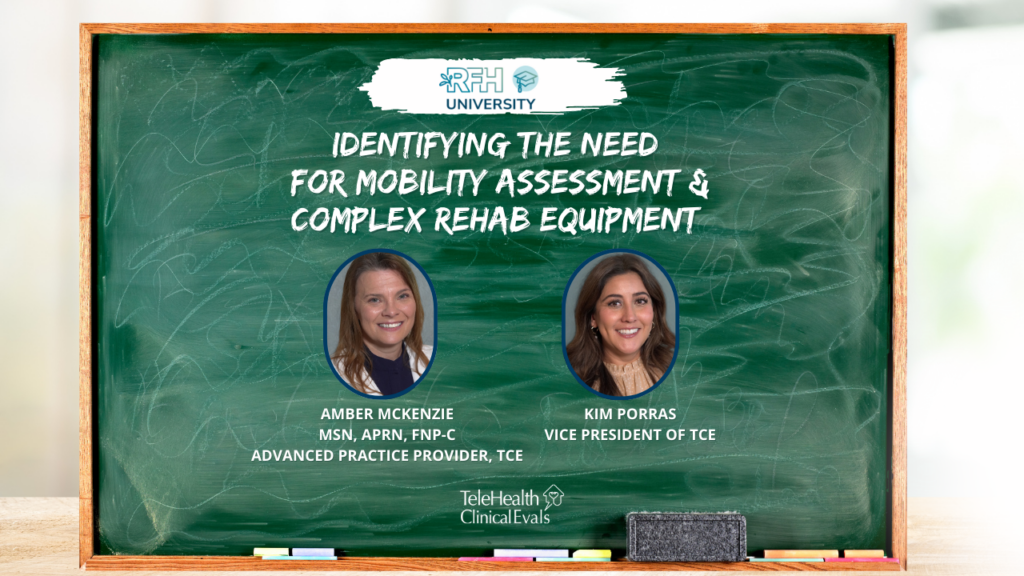
In an RFH University session, Kim Porras and Amber McKenzie, NP, from Telehealth Clinical Evals (TCE), discussed how mobility assessments and coordinated Telehealth evaluations reduce fall risk, speed complex wheelchair approvals, and improve patient safety at home.
Watch: RFH University | Identifying the Need for Mobility Assessment and Complex Rehab Equipment with TCE
What Is a Mobility Assessment?
A mobility assessment evaluates a patient’s ability to safely perform mobility-related activities of daily living in the home.
A comprehensive mobility and fall risk assessment includes:
- Gait analysis and walking stability
- Transfer mechanics
- Balance and strength testing
- Cardiopulmonary endurance
- Medication review for fall risk
- Environmental hazards in the home
These assessments help determine whether a patient needs a cane, walker, therapy services, or complex rehab technology such as a manual or power wheelchair.
Early identification of mobility impairments reduces fall risk, pressure injuries, wound complications, and hospital readmissions.
Why Complex Wheelchair Approvals Get Delayed
Traditional complex rehab equipment approvals require separate physician visits, therapy evaluations, documentation submissions, and insurance reviews. Delays can stretch for months.
During that time, patients with Parkinson’s disease, stroke, multiple sclerosis, ALS, or severe arthritis may experience worsening mobility, increased fall risk, and pressure injuries.
TCE’s coordinated telehealth mobility evaluation model combines a physician or advanced practice provider, a therapist, and an assistive technology professional in one visit.
This reduces:
- Documentation errors
- Insurance denials
- Administrative burden
- Equipment approval delays
Documentation is typically completed within two business days, accelerating access to medically necessary mobility equipment.
Fall Risk and Wound Care Are Connected
Mobility limitations directly impact wound healing and pressure injury prevention. Improper seating, outdated wheelchairs, and poor positioning increase skin breakdown and hospital risk.
By integrating mobility assessments into mobile wound care and chronic condition management, Restore First Health helps:
- Reduce fall-related emergency visits
- Prevent pressure injuries
- Improve aging in place
- Decrease hospital readmissions
Watch the full RFH University session to learn how telehealth mobility evaluations and fall risk assessments improve outcomes for patients at home.
Follow us on social media for more health tips, videos and education.